
Learning Objectives
- Recognize the Internet’s fundamental historical figures.
- Determine the basic spectrum of historical technologies leading to (and including) the first examples of social software.
- Identify the difference between things like the Internet, the WWW, USENET, etc.
World’s Briefest History of the Internet
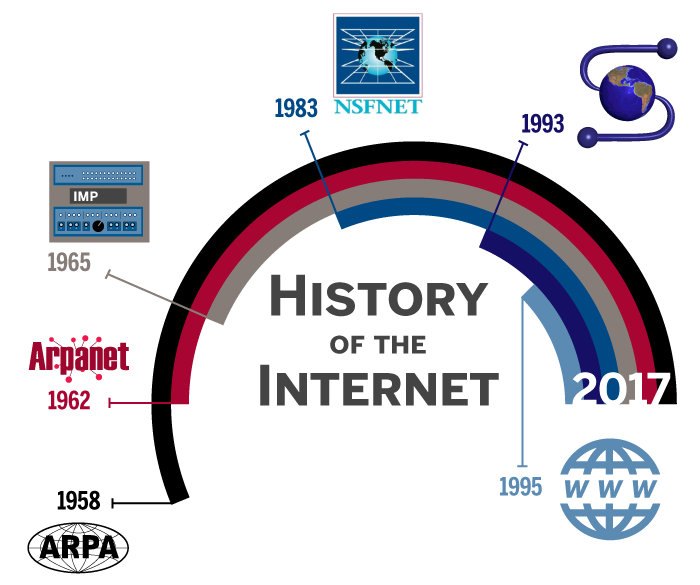
Russia launches a satellite which terrifies the US Government and forces them to create ARPA (and SAGE), which begat the first internet: ARPANET. ARPANET connected computers together with NCP, but this was replaced by the now ubiquitous TCP/IP protocol.
ARPANET was retired and became the public NSFNET and the private military MILNET. Still small, the NSFNET grew by connecting other new nets such as the EUNET (Universities and Research Entities in Europe) and CSNET (North American Universities).
From the beginning, these networks were designed for communication and social interaction. The email was a killer app long before the web was created! Systems like USENET and IRC were implemented and continue to be popular to this day, both in their essentially original forms and in their many modern derivatives (bulletin boards and forums, Google news, instant messenger).
As computers became more commonly available and the Internet more accessible, researchers began thinking of ways to use these new technologies and connections. On the technology side, the mouse, hypertext, and the first GUI interface were created. The GOPHER system was the first attempt at providing a distributed document search and retrieval system. Were it not for some strange decisions about charging for access to the GOPHER code and– perhaps more importantly– a strict, hierarchical system of categorization, GOPHER may well have reigned for a long time. On the connection side, Tim Berners-Lee created the first basic hypertext-based, connected linking, and browsing system– in other words, the first WW (wide web). Thanks to lobbying by Tim to make the code he had created available to all, public interest took over and this soon became the World WW, or the WWW, as we essentially know it.
But the web is still involving! The most active areas of growth include:
the ascendancy of “blogs” (meaning: the ability for anyone to publish to a potentially worldwide audience with very little technical skill and without expensive hardware)
social networks where people can work and play together (Facebook, MySpace, LinkedIn)
collaborative editing and writing tools (wikis)
social applications that bring formerly individual activities into the public sphere (delicious, Diigo)
social media (creation and sharing of audio, photos and video)
the Web 2.0 meme (which means many different things, but most of the time all of the above + a recognition that this stuff matters to business)
the IoT (the Internet of Things): people are not the only ones who are connected to the Internet; cellphones, cars, and even houses are now online collecting and exchanging data
wearable technology: from clothing accessories to gadgets that perform functions (do you own a Fitbit?)